getting-started
What Is Video Journaling? A Guide to Six Different Formats
Learn what video journaling means, how it differs from vlogging, one-second montages, research diaries, and video journalism, and which format fits you.
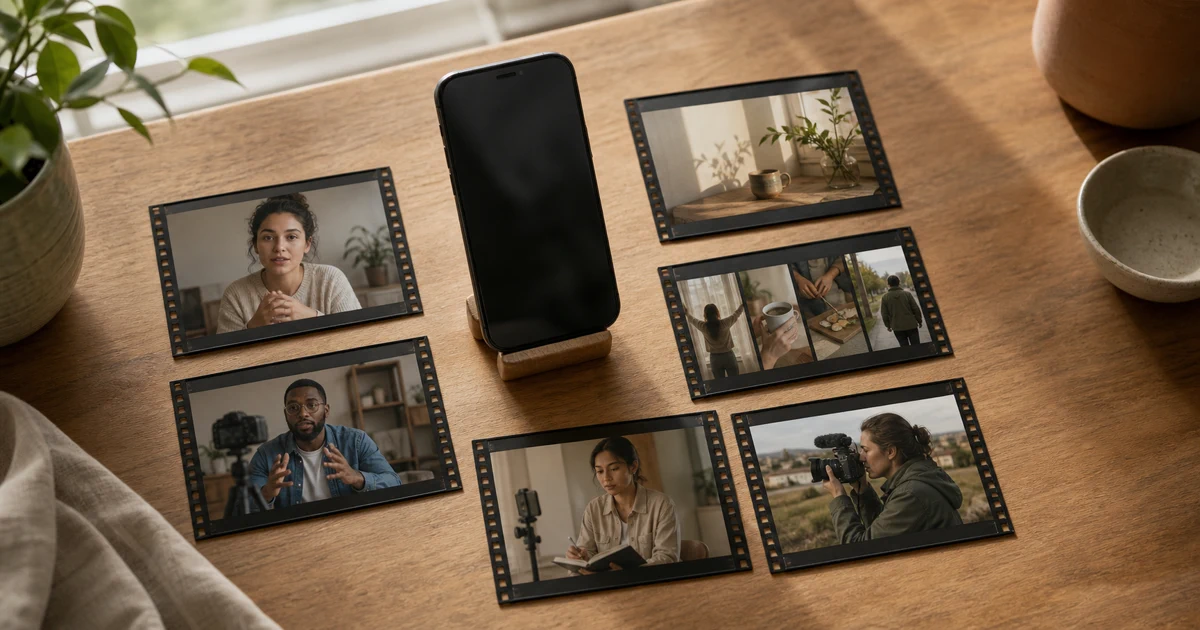
Video journaling is the practice of making video entries over time to record your thoughts, feelings, experiences, or everyday life. A video journal can be a series of private recordings of you talking to the camera, but it can also be a visual record made from short scenes. It does not have to be published, edited, recorded daily, or shared with anyone.
That broad definition explains why the term can be confusing. A one-minute reflection, a one-second clip from each day, a public vlog, and a research participant's recorded response may all be called a video diary. They use the same medium, but they do different jobs. The simplest way to identify the format is to ask what each entry contains, who it is for, and what happens to it next.
The short definition
The Cambridge Dictionary definition of a video diary describes a film in which someone regularly records thoughts, feelings, or events over time. Three parts matter:
- Video is the record. The entry keeps visible or spoken information rather than relying only on written words.
- There is more than one moment. A single recording can be personal, but the journal appears as entries accumulate.
- The subject is your experience. The material may include reflection, daily events, people, places, or changes you want to remember.
Privacy is common, not guaranteed by the word journal. A video diary can stay on one device, sync to a private account, be shared with family, or later be released publicly. The label tells you what is being recorded. The storage and sharing settings tell you who can see it.
Six formats people mean by video journaling
This taxonomy separates formats that current definitions and products often place under the same label.
| Format | Include it when... | Do not confuse it with... | Main job |
|---|---|---|---|
| Talking-head reflection | You speak to the camera about a thought, feeling, decision, or event and keep entries over time. | A public creator video made for viewers. | Preserve your words, voice, expression, and point of view. |
| Private life documentation | You record places, people, routines, or scenes as a dated personal record, with or without narration. | A single home video with no journal or sequence around it. | Keep visual evidence of how everyday life looked. |
| One-second memory montage | You select very short clips from different days and combine them into a recap. | A spoken diary entry that develops one thought. | Compress a period of life into a quick visual timeline. |
| Public vlog | You film experiences or opinions as a video blog and publish them online for an audience. | A recording that remains a personal archive. | Inform, entertain, or connect with viewers. |
| Research video diary | A participant records experiences or responses over an agreed period for a study. | A private journal made only for the participant's own use. | Give researchers repeated, first-person material to study. |
| Video journalism | Video is used to report or broadcast nonfiction subjects for the public. | A personal account whose primary purpose is self-recording. | Document and communicate news or documentary information. |
The categories can overlap. A research participant may record a talking-head reflection. A private life-documentation project may later become a public vlog. The useful distinction is the job of the recording at the time, not the camera, clip length, or editing style.
Talking to the camera is one form, not the whole definition
For many people, video journaling means sitting down and speaking freely. The camera becomes the place where they explain what happened, name how the day felt, or keep an unfinished thought. This is the format closest to a written journal entry, with voice and expression added.
An Oxford Brookes guide to video diaries describes them as a way to record reflective diaries or elicit views and comments. It notes that entries are usually private and relatively unstructured. It also names the less romantic parts of the medium: some people dislike talking to a camera, files can be large, and recordings take work to review.
None of that means a journal must show your face. You can point the camera at the room while you narrate, record only the scene, or mix direct reflection with ordinary details. What keeps it inside the definition is the repeated personal record.
A visual diary can record life without a spoken reflection
Private life documentation puts the scene ahead of the explanation. You might record the kitchen in a first flat, a walk you take every week, or a family routine that is slowly changing. A short caption, date, or spoken sentence may provide context, but the image is doing most of the remembering.
A one-second montage is the most compressed version of this approach. The current 1 Second Everyday App Store listing separates day-to-day journal projects from event or trip projects and builds longer “mashes” from short snippets. That fits the broad video-diary definition, but its unit of meaning is a selected glimpse. A talking-head journal keeps a developed thought instead.
Choose the visual form when you want a fast recap of change. Choose spoken entries when the explanation, uncertainty, or delivery is the part you expect to value later. You can keep both, but they should not be presented as identical habits.
A video journal is not automatically a vlog
A vlog is a video blog published on the internet. A video journal can remain private. That publication boundary is more useful than trying to separate them by polish.
Either format can be carefully edited or recorded in one take. Either can show an ordinary day. A diary can have beautiful lighting, and a vlog can be rough. The practical difference is the intended viewer and distribution.
Publishing changes the recording. An outside viewer may need context that future you already has. Other people in the frame need a fresh consent check. Titles, comments, analytics, and audience response may start shaping what you make. The full video diary versus vlog comparison follows those differences through privacy, editing, feedback, storage, and monetization.
Research video diaries have a named viewer
In research, the camera entry is personal material collected for someone else's study. A peer-reviewed description of video-diary data collection with children defines the method as repeated recordings of participants' lives over an agreed period. The researchers supply instructions, receive the recordings, and analyze them alongside other study material.
That is different from a private journal even when the participant speaks alone at home. The intended viewer is known, the topic may be assigned, and consent, withdrawal, data handling, and possible harm belong to the research design. “Recorded in private” does not mean “kept private from the research team.”
Video journalism reports outward
Video journalism sounds similar, but its purpose is different. Dictionary.com defines video journalism around preparing and broadcasting nonfiction news or documentary subjects.
A journalist may appear on camera, use first-person narration, or document events over time. Those choices do not make the work a personal journal when its main job is reporting to the public. If you are searching for how to report, interview, verify, edit, or publish a news story, you want video-journalism guidance. If you want a recurring record of your own life or reflection, you want video journaling.
How to choose the version you mean
Answer these four questions before choosing an app or setup:
- What should one entry hold? A developed thought points to talking-head reflection. A glimpse of the day points to visual documentation or a montage.
- Who is meant to watch it? Future you suggests a private journal. Participants, viewers, or a research team create different consent and context needs.
- What should happen over time? You may want dated entries to replay, short clips to combine, study material to submit, or episodes to publish.
- How will you find and protect it? Check labels, dates, storage, account access, sharing, analytics, and whether raw video will be practical to review.
If you want to talk privately but are unsure whether video suits you, compare it with writing first. The video-journal-versus-written-journal guide covers camera comfort, search, storage, and review time. If you already know you want video, the seven-day starter guide keeps the first test small.
Where Vidiary fits
Vidiary is an iPhone app for private talking-head reflection. You record a journal video, can optionally name the entry and add mood tags, and return to earlier entries by date. It is built for the moment when you would rather talk than compose a written page.
It is not a one-second montage editor, research collection tool, video-newsroom workflow, or public vlogging platform. It does not have a public feed. Journal videos use your iCloud and CloudKit account, while PostHog product analytics and RevenueCat subscriptions are part of the app's separate data picture. “Private video journal” describes where the entries fit in this taxonomy; it does not mean that no other data is collected.
Before recording anything sensitive, use the private video-diary checklist to check device access, cloud settings, copies, and disclosures.
Common questions about video journaling
Do I have to show my face in a video journal?
No. You can speak to the camera, narrate while filming a place or object, or keep a sequence of visual clips with no narration. Showing your face is useful when expression is part of what you want to preserve, but it is not part of the definition.
Does video journaling have to be daily?
No. The journal needs entries over time, not a perfect streak. Daily snippets suit a montage. Weekly or event-based entries may fit a reflective journal better. Pick a rhythm that matches what you want the record to show.
Is video journaling private?
It can be, but the term does not guarantee privacy. Check the app, device lock, cloud account, backups, sharing controls, and analytics disclosure. A private intention is not a technical access control.
Is a one-second-every-day project a video journal?
Yes, as a visual or montage-style video journal. It records life over time, but it preserves selected glimpses rather than a developed spoken account. Use it when the changing view matters more than a full reflection.
What is the difference between video journaling and video journalism?
Video journaling records personal thoughts, feelings, or life over time. Video journalism prepares and communicates nonfiction news or documentary material for the public. First-person footage can appear in both, so purpose matters more than whether the person holding the camera appears on screen.
Choose the row in the taxonomy before choosing the tool. If the row is private talking-head reflection, try one short entry with Vidiary and let it stay unfinished. If you need a prompt, use the seven-day starter guide. Return when there is another moment you want to keep; the first recording does not need to look polished.