getting-started
How to Document Your Life Without Recording Everything
Build a useful record of ordinary life with the smallest photo, note, audio clip, or video that preserves the scene, voice, context, or meaning.
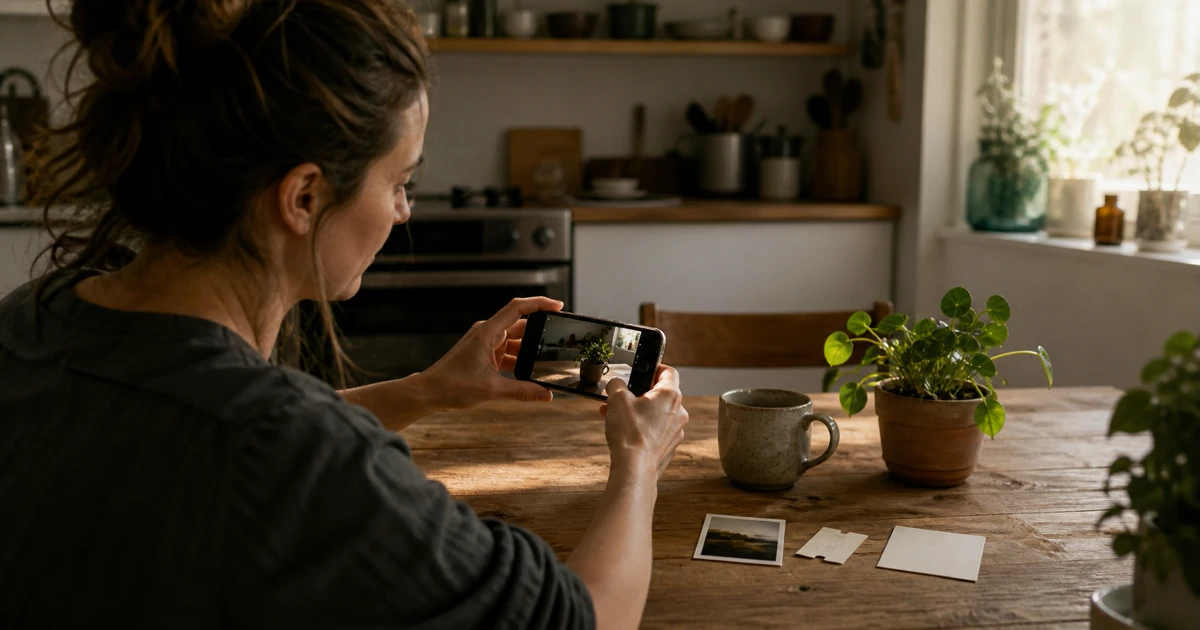
Document your life by deciding what future you should be able to recover, then saving the smallest record that preserves it. Use a photo or short clip for a scene, audio or video for voice, a dated note for context, and a short written or spoken reflection for meaning. Add enough detail to find it, choose a time to revisit it, and make a separate preservation copy only for material with lasting value.
You don't need a complete record of every day. That goal creates a second life made entirely of filing. A useful personal record is selective. It keeps one detail that would otherwise disappear and enough context to make that detail understandable later.
A record of current life and a retrospective life story are different projects. A life story looks back across years and organizes past memories into chapters. Ongoing documentation catches the kitchen you use now, the way you describe an unfinished decision, or the small routine that has not yet become a memory.
Start with what you want to recover
Choosing a format first is how a simple idea turns into a shopping problem. A new notebook suggests long entries. A camera suggests beautiful scenes. A scrapbook suggests supplies. None of those choices answers what you want the record to do.
Start with this sentence instead:
When I return to this, I want to recover...
The answer usually falls into one of four jobs. A scene keeps what a place, person, object, or visible change looked like. Voice keeps how you or someone else sounded, including pace and expression. Context keeps the names, dates, facts, and connections that make an item understandable. Meaning keeps why the moment mattered or what was uncertain at the time.
One entry does not need all four. A photo can keep the scene while a caption supplies the context. A short video can keep voice and meaning together. A receipt with three names on the back may do more for a future memory than ten unlabelled clips.
If your real project is to organize past memories into a bounded autobiography, use the eight-chapter life-story method instead. The method below is for keeping present-day life as it happens.
Use the smallest useful record
The smallest useful record keeps the part you care about without turning capture into production.
| If future you should recover... | Save this | Add this context | Revisit when... |
|---|---|---|---|
| The scene | One photo or a few seconds of video | Date, place, and why this view matters | The place, routine, or season changes |
| The voice | One short audio or video entry | Speaker, subject, and a recognizable name | An anniversary or later change gives it distance |
| The context | One sentence, caption, list item, receipt, or memento | Proper names, date, and the missing connection | You need to reconstruct the person, place, or decision |
| The meaning | One short written or spoken reflection | What happened before what you think it means | The outcome is known or your view has changed |
For a scene, photograph the mugs on the kitchen counter during the first week in a new flat. Label the flat and month. Photo quality matters less than the arrangement that will stop being visible once the kitchen becomes familiar.
For voice, record one minute about why today's team lunch felt different. Name it "last lunch before the office move" so you can recognize it without replaying a folder of clips.
For context, keep a concert ticket with the date, venue, the name of the person who went with you, and the song you discussed on the way home. The ticket alone may become an unexplained object.
For meaning, record the unfinished version of a decision: "I accepted the offer today. I am excited about the work and unsure about the move." Keep that version before the outcome gives the story a cleaner shape.
If writing is the part that keeps stopping you, the guide to journaling without writing compares audio, photos, quick check-ins, and video by what each format preserves and what it makes harder.
Include ordinary life without recording everything
Big events already announce themselves. Weddings, graduations, trips, and new jobs tend to attract photos and messages. Ordinary details look disposable because they are still around.
A 2014 paper in Psychological Science tested this prediction across four studies. Participants created written records of current experiences and later rediscovered them. They underestimated how curious, interested, or pleased they would be when they returned, especially when the original experience had seemed ordinary. In one study, people also passed up a chance to document a current conversation, then later preferred rediscovering it to another available activity.
The study supports one narrow choice: include a few mundane details. It does not support recording every breakfast. The studies used written prompts and accounts, not video journals or lifelong archives. They did not show that daily documentation improves memory, wellbeing, or satisfaction. The authors also noted possible costs when recording distracts from the experience itself.
Use the evidence narrowly. Keep one detail that feels too familiar to need saving: the route under construction, the phrase a child currently mispronounces, the view from a regular seat, or the reason Tuesday felt different from Monday. Then put the phone away.
Build a capture, context, and revisit loop
The method has three parts.
Capture one thing
Choose one row from the matrix. Do not make a photo, video, written entry, and scrapbook page for the same moment unless each one has a distinct job.
Add enough context
Name the people, place, and date while they are obvious. Add one sentence about why you kept the item. "Dinner" will not help much in three years. "First dinner at Ania's flat after her move, August 2026" probably will.
For spoken or video entries, a short title can be more useful than a long summary. It reduces the need to replay several files just to find the right one.
Choose a deliberate revisit
Set a revisit that matches the subject, not a universal schedule. Return to a moving-day entry after three months, a seasonal view next year, or one decision after the outcome is known. You can also review one small sample at the end of a month.
Don't treat the revisit as a test of whether you documented correctly. Ask whether the record kept the scene, voice, context, or meaning you wanted. If it didn't, change the next entry rather than repairing the whole archive.
The two-pass journal review worksheet gives you a bounded way to look back without turning one old record into a sweeping conclusion.
Keep the system light enough to live beside
The current search results include notebooks, apps, voice memos, photos, mementos, and mixed journals. A direct community question about documenting a life shows why the list does not settle the choice. The writer was overwhelmed by long-form journals, multi-year journals, and scrapbooks. Replies repeatedly suggested trying a small format, keeping what is pleasant to revisit, and changing systems when needed.
Those replies are anecdotes, not proof that flexibility guarantees consistency. They do reveal the decision readers are trying to make. They want a record they can create now and understand later without maintaining a museum of themselves.
Run a four-record test:
- Keep one scene.
- Keep one voice.
- Keep one piece of context.
- Keep one unfinished meaning.
Review the four records after a week. Notice which were easy to make, which still make sense, and which you would voluntarily open again. Keep the useful formats and drop the rest.
Treat preservation as a separate job
Capture and preservation solve different risks. Capture prevents a detail from disappearing today. Preservation keeps selected material available after a phone, account, app, drive, or file format changes.
The Library of Congress personal-archiving guidance recommends deciding which files have long-term value, giving them descriptive names, organizing them, making at least two copies in different places, checking the files at least once a year, and moving them to current media when needed.
Reserve that preservation work for records that would be costly to lose. Keep their context with them. Make independent copies that you can open without relying on the capture app.
Cloud sync is useful, but it isn't automatically an independent archive. A synced deletion may spread. An account may become unavailable. If a product does not provide a verified export path, do not make it the only home of material intended to last for decades.
For a deeper project meant for family or future generations, the life-story guide includes a separate preservation plan. For sensitive video, check the private video-diary checklist before adding more copies.
Where Vidiary fits
Vidiary fits the voice row when the memory includes how you said it. It is an iPhone video diary for short private recordings. You can optionally name an entry and add mood tags, then return to past entries by date. A one-minute account can keep your words, pace, expression, and the room around you together.
Vidiary does not currently provide photo scrapbooking, audio-only capture, transcription, automatic memory summaries, or a verified export workflow. It should not be the only preservation plan for records you want to keep outside an app or account.
Journal data uses your iCloud and CloudKit container and is not posted to a public feed. Vidiary also uses PostHog product analytics and RevenueCat for subscriptions, so private journal videos do not mean that no other data is collected.
Use Vidiary when spoken video is the smallest useful record. Use a photo, note, receipt, audio tool, or mixed system when another row fits better.
Common questions about documenting your life
What parts of my life should I document?
Keep ordinary details that are likely to change or lose their obvious context: rooms, routines, voices, relationships, decisions, favorite objects, local places, and unfinished thoughts. Choose one item because you expect to revisit it, not because every day needs evidence.
How often should I document my life?
There is no required cadence. Record when a scene, voice, fact, or meaning would be hard to reconstruct later. A weekly item or one entry during a change may produce a more useful archive than a daily quota you resent.
What is the best format for documenting a life?
The best format depends on the memory job. Photos and short clips keep scenes. Audio and video keep voice. Captions, notes, and mementos keep context. Written or spoken reflections keep meaning. Use more than one format only when the extra format preserves something distinct.
How do I preserve a digital life record?
Select what has lasting value, use descriptive names, keep the context with the files, and maintain at least two independent copies in different places. Check that a sample still opens at least yearly and move the collection when its storage or format becomes outdated. Do not assume sync alone provides that protection.
If your voice and expression are the part you want to keep, open Vidiary and record one ordinary minute. Give the entry a name you will recognize later, then choose a date to revisit it. If the first question feels too large, use one of the one-minute video-journal prompts.